Canto tutorial
This site contains a step-by-step video and text guide for curating a paper using Canto. If you have received a link to curate a publication, follow the instructions below. If you want to curate a paper, but have not received a link, see this page.
Getting started
- Click on the email you have received, this should open Canto in your browser.
- Click on
Start curating. If you want to delegate curation to someone else, clickReassign paper”. Note: you can also begin curation and reassign the session later; there is aReassignbutton in the upper right corner of the curation summary page. - You will be required to log in. Enter your information and click
Continue. - In the next page, you can add the list of genes that are mentioned in the paper and that you will be using for annotations later.
- You can add multiple genes separated by any spacer (space, commas, line breaks).
- You can refer to genes by their systematic id (SPAC3G9.12), primary name (peg1) or a synonym (cls1).
- If a gene name is also the synonym of another gene (e.g. psu1), you will be asked to provide a systematic ID for that gene.
- You can add genes later, so you don't need to include an exhaustive list at this point.
- You will then be asked to double-check the list of genes, and then you can proceed to curating your paper.
- If the paper does not mention individual genes, check the box labeled
This paper does not contain any gene-specific information. You can then directly complete the session by clickingContinueand thenFinish. -
The tutorials in this page use Canto advanced mode, it can be activated as shown below:

Creating annotations
Depending on the publication, you may be able to add different types of annotations (we recommend this order). Follow the links below to see videos and text showing how to do it:
- Genotypes
- Phenotypes
- Genetic interaction: rescues, synthetic lethality, etc.
- Physical interaction: for protein and RNA molecules.
- Protein modification: phosphorylations, palmitoylation, etc.
- Protein sequence feature or motif: residue range where a certain sequence feature is present (e.g. signal peptide).
- Wild-type RNA or protein levels: gene expression during a cell cycle phase, response to stimulus (e.g. heat response) or in presence of a drug.
- Gene Ontology:
- Molecular Function: single-step activities such as
kinase activityortransporter activity. - Biological Process: a series of functions with a common goal such as
MAPK cascadeorcytokinesis. - Cellular Component: location where the gene product can be found, and what complexes it is part of, for instance
nucleusorfatty acid synthase complex.
- Molecular Function: single-step activities such as
Please note that you should only curate information supported by experiments presented in the paper. If you want to capture other information not directly shown in a particular paper, please contact the curators to discuss how to proceed.
You do not need to complete the whole curation in one session. All curated information is preserved, you can click on Pause curation and come back to the URL provided in the invitation email at any time.
Use the Contact curators link at any point if you get stuck, or have any question.
Finishing and submitting
Once you have finished entering data from your paper, click the Submit to curators.
If your article does not contain any type of data that can be curated in Canto, check the No experimental results to add? box and select a reason from the pulldown menu that appears:
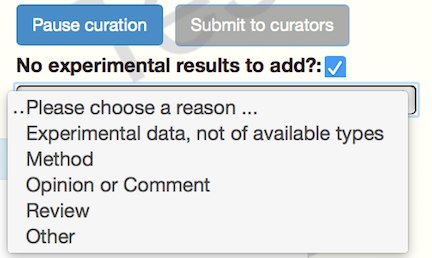
After you click Submit to curators, you will be provided a text box in which you can enter any additional comments you would like to share with the curators.
Other useful links
- Productivity: save time in sessions with a lot of annotations.
Funding
This Canto documentation project was funded by the ELIXIR-UK: FAIR Data Stewardship training UKRI award (MR/V038966/1).